Accelerating Sensitizer Discovery via Deep Learning
Triphenylamine (TPA) is one of the most prominent donor moieties in donor-π-acceptor (D-π-A) organic sensitizers. This application utilizes deep neural networks trained on experimentally validated photovoltaic metrics to predict four essential device parameters simultaneously: Short-Circuit Current Density (Jsc), Open-Circuit Voltage (Voc), Fill Factor (FF), and Power Conversion Efficiency (PCE%) directly from chemical SMILES strings.
Model Specifications
-
Primary Input: Standard canonical SMILES notation or batch molecular list
-
Molecular Descriptors: Topological polar surface area, electronic charge distributions, and Daylight fingerprints
-
Target Outputs: Jsc (mA/cm²), Voc (V), FF (0–1), and PCE (%)
-
Validation: Cross-validated against DFT calculations for oscillator strength and excited-state charge transfer
Input Modalities for PCE Prediction
Flexible molecular entry modes supporting single-molecule design and automated database screening.
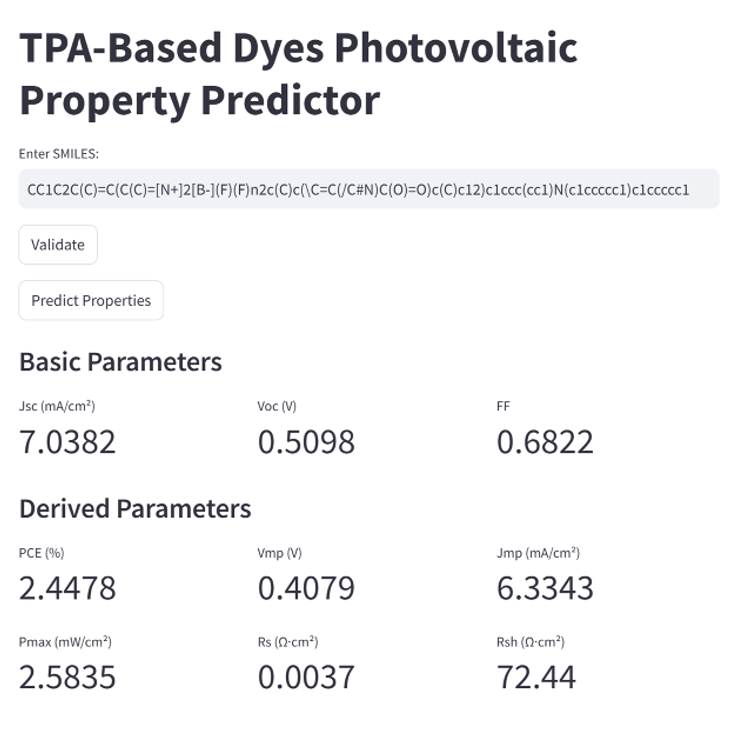
Single Molecule: SMILES Format
Draw your target organic dye in any chemical sketching package (e.g., ChemDraw, MarvinSketch, or JSME) and copy its canonical SMILES string. Paste the SMILES directly into the prediction prompt.
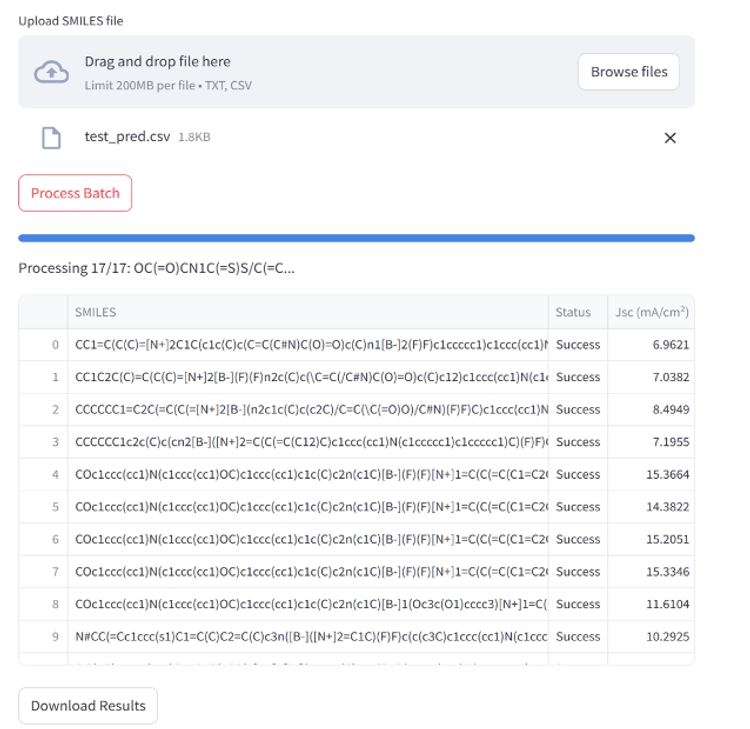
High-Throughput Batch Screening
Upload a .txt or .csv file containing hundreds of candidate SMILES strings. The model performs parallel vector inference and outputs a ranked spreadsheet of predicted PCE% values.